France: Beyond the "Emily in Paris" Myth – Embracing the Expat Reality
We all have a mental image of France before we even set foot on its soil. But there is a world of difference between the "digital postcard" and the "Parisian pavement." To truly understand a country, one usually passes through three distinct prisms, and the transition between them can trigger a genuine "emotional earthquake."
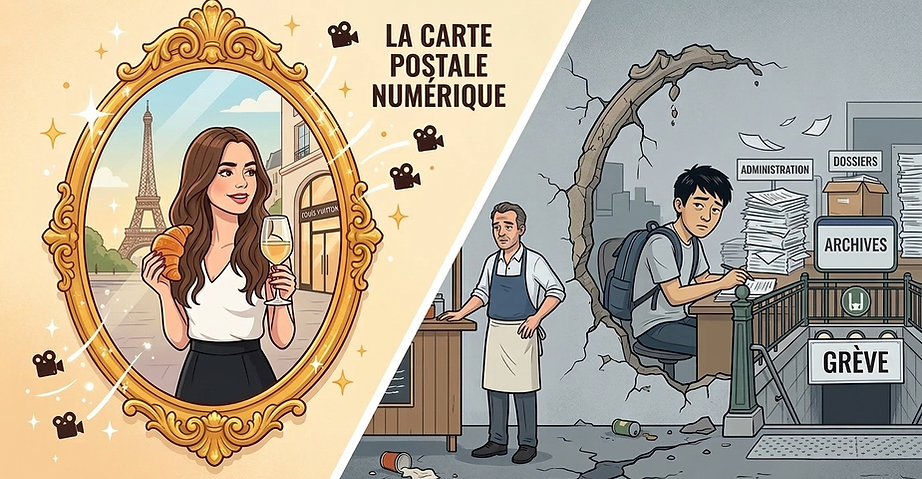
The Distorting Mirror
Historically, France has been a master of its own global image, from the grandeur of Versailles to the invention of cinema. Today, algorithms have taken over that role.
The first prism is created by television and cinema. This is the most biased perspective: the world of Emily in Paris or Amélie. Here, France is reduced to the Eiffel Tower, Louis Vuitton, perfect croissants, and a glass of wine on a terrace. It’s a studio decor—sterile, without trash, without strikes (grèves), and devoid of social complexity. Scientifically, these images hardwire idealized expectations into our brains, creating a sort of visual "artificial paradise."
The Tourist vs. The Expatriate
The second prism is that of the vacationer. It is a pleasant but superficial view. You skim the surface, seeing only what is beautiful. But France cannot be summarized by the romanticism of the Seine or the cliché of the beret.
The real shock happens at the third stage: expatriation. This is where you finally confront cultural and social reality.
Saturation: You discover the labyrinthine administration, the sometimes blunt nature of social interactions, and the underlying social fractures (much like the volunteers at the Paris Olympics who witnessed the contrast between the glitz and the "shadow workers").
The Collapse of the Dream: Feeling disappointed is perfectly natural. It’s not that the country is "bad"; it’s that the distorting mirror created by the media is finally shattering. You feel like your dream is crumbling, but in reality, you are finally starting to see.
A Teacher’s Perspective
Having lived in Japan and Spain, I have witnessed this culture shock from both sides. Many students arrive in France with "Paris Syndrome"—a disappointment so profound it manifests physically.
As a teacher, my role is to tell you: do not be saddened by this disillusionment. It is the sign that you are escaping the lure (le leurre). The real France is far more fascinating than a Netflix series. It is complex, contradictory, often grumpy (râleuse), but it is this very authenticity that makes it rich. Learning the language is exactly that: obtaining the key to understanding why the French are the way they are, far beyond the "marinière-baguette" costume.